Monday, November 16, 2009

THE HITTING COACH QUANDARY FOR ST. LOUIS (3 of 3) - Why Mark McGwire is a Good Fit for the Cardinals

There are many popular arguments that challenge how successful Mark McGwire will be in his new position as hitting coach; I for one, however, believe that Mark McGwire will not only survive, but thrive as the hitting coach for the Cardinals. Here are three countered arguments and points of interest that accompany Mark McGwire’s return to St. Louis:
1. Both St. Louis and three of its coaches (he played under La Russa, Duncan, and Dave McKay as a member of the Oakland Athletics) are familiar settings for McGwire. Not only did he enjoy five years of glory and success as a St. Louis Cardinal, but also played under Manager Tony La Russa for fourteen years. These stats alone should aid his reappearance in a Cardinal uniform (once again under the leadership of skipper La Russa), but they scratch the surface. McGwire has instructed both Matt Holliday and Skip Schumaker in previous off-seasons, and both players prove different points of success for the new Cardinal Coach. First, although Holliday may not be a Cardinal in 2010, his existence as a “franchise player” (according to agent Scott Boras) evidences that McGwire has at least some knowledge in the field of hitting; in a combined 6 seasons, Holliday has hit a total of 152 homeruns, has hit for a career .318 batting average, and has driven in 592 runs. Not only can McGwire coach power, but Skip Schumaker (career batting average of .301) evidences his ability to coach a hitter with a low source of power, but a high career average.
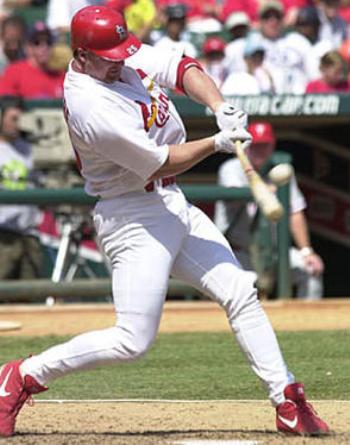
2. A common argument that has arisen since the announcement of Mark McGwire as hitting coach is that, “Because Mark McGwire was a power hitter, his “homerun swing” will make it impossible to coach a singles-type hitter.” Along with the proof of Skip Schumaker as a base-hit hitter with a high batting average, I would like to address a few basic points about McGwire’s swing when he was a ball player. Although McGwire had what some would call a “homerun swing,” his swing contained essential elements to being a successful all-around hitter. First, contrary to a stereotypical “homerun swing,” he successfully transferred his weight from his back foot to his front foot, and made contact with the ball out in front of the plate. Second, he hit against a firm front leg and also contrary to a “homerun swing,” finished with a 90 degree angle between his back foot and the ground, instead of “squishing the bug.” Third, he had a high follow-through which is important for any hitter, because it allows them to hit through the ball and get full extension. There were elements of his swing that made him hit homeruns, though. First, he started his swing by dropping his hands, which allowed him to get under the ball and hit towering fly balls for great distance. Second, after he finished his follow through: after his swing, he transferred his weight back to his back foot, which also helps to generate an upward stroke. If you eliminate these aspects of his swing by keeping the hands up at the beginning of the stride, and finishing balanced and out in front, the tall homeruns transform into scorching line-drives and the resulting product is a great swing.
3. As stated before, the most important part of a hitter’s game and a hitting coach’s job is preparing for the mental game. McGwire was a power hitter that took a calm approach to his swing, and had a game plan of capitalizing on the pitcher’s mistakes and dominating the pitch that he hit. Before stepping into the batter’s box, McGwire could be found with his eyes closed, going through visualizations about how he would hit the pitcher and what he would do in each situation. This is exactly the mindset that the Cardinals need when they go up to bat. McGwire will teach them how to be confident at the plate and to make sure they are the ones that dictate the game, not the pitcher.
Mark McGwire will be a successful hitting coach in St. Louis. Beyond skepticism from outside sources, Mark McGwire’s hitting instruction has already paid dividends for himself and other ballplayers, and will bring a stable source of hitting knowledge and instruction (physical and mental) to the table when he joins the Cardinals for the first Spring Training game on March 4, 2010.


THE HITTING COACH QUANDARY FOR ST. LOUIS (2 of 3) - The Position of Hitting Coach

A player reaches the Major League level, because he is the best at his trade and either has immense talent or has perfected his particular craft in the game of baseball; thus, once a player has made it to “The Show,” there is often little need to educate one in the basics of the game, but rather to preach and sustain the fundamentals while continuing to advance one’s skill at the highest possible level. It has been said that baseball is 10% physical and 90% mental, and the same is true for all aspects of the pastime, on and off the field. Sometimes a need arises to adjust a pitcher’s release point or to tweak a hitter’s load, but the main focus of a coach is to modify and regulate a player’s mental approach to the game.

Before each game, the hitting coach spends countless hours viewing and reviewing video tape, working with the players on soft toss and tee work, and last but certainly not least, preparing a hitter with a game plan. The physical work is important: you cannot expect to stay successful in the Majors if you do not build muscle and muscle memory, but the mental aspect of the game is dire. Also at the Major League level, you cannot expect to stay successful if you do not have a sound psychological method of facing the opposing pitcher when you step up to the plate. It is of the utmost importance to organize one’s thoughts before starting the game and entering the batter’s box: you must know what you will do with “x” number of runners on base, with a “y” count, with “z” outs, and if you are a lefty and Mariano Rivera offers up a cutter on the inside third of the plate. It is a large part of the hitting coach’s job to discuss with each player a pitcher’s key features and what a hitter must do to be successful against the opposition.

In the upcoming 2010 season, it will be Mark McGwire’s job to not only tweak aspects of his hitters’ swings, but more importantly to teach his army how to approach each impending battle, and prospectively win the war.


THE HITTING COACH QUANDARY FOR ST. LOUIS (1 of 3) - Some Objections Answered

Saturday, October 10, came as a disappointing day for Cardinal Nation; many of us watched in disbelief as the last few weeks of the season sputtered and surceased to a disheartening halt. Let’s take a brief look at the second half of the season: already contenders for National League Central Division Champions, the acquisitions of Mark DeRosa and Matt Holiday added some much needed “pop” to the Cardinal’s lineup. Now, both the defensive and offensive aspects of the team created a bright outlook for the Redbird’s future. The Cardinals ran away with the division title, annihilating the second place Cubs by 7.5 games, and had their sights set on a potential World Series victory. The end of the regular season, however, was demoralizing to say the least; the Cardinal’s previously dominant top starters had lost their last few starts, and key hitters had sunk to an abyss of incurable slumps. It was not just the fact that the Cardinal’s didn’t win the World Series, but that their post-season ambitions were squelched in three short games. This unexpected and abrupt end to the season led to many questions being asked of the disappointing loss and what the future of next year’s team might be.
Among these questions were inquiries about the underperforming offense and the increasingly notorious question about the prospective coaching staff, “Will Dave Duncan choose to return after what happened to his son?” and “Will Tony La Russa return for the 2010 season?” The answer to both questions came on October 26, when Duncan and La Russa announced their plans to stay with the club for 2010. Packaged with these relieving answers, however, was the hiring of Mark McGwire.
The ineffective level of offense that led to the conclusion of the Cardinal’s season brought forth questions about the integrity of the 2010 Cardinal lineup, and in order to appease the disconcerted fan base and public, former hitting coach Hal McRae was handed the pink slip. When an important facet of a team underperforms, it is often that somebody needs to take the blame, and a member(s) of a coaching staff is fired; in the case of a lack of productive hitting, the fall guy happened to be the hitting coach. Sometimes change does not have a fundamentally sound foundation, and is just made for the sake of change, and for the restoration of the public’s confidence; the front office needs to confront questions posed by media, and the CEO needs to make sure that the season ticket holders (and their revenue) return.
This challenge was met head-on by the appointment of Mark McGwire to the position of hitting coach, and posed a whole new set of inquisitions.


Albert Pujols is only one of the many members of the St. Louis Cardinals that will have to continue to perform on offense if the Cardinals want to win in 2010.