1. Both St. Louis and three of its coaches (he played under La Russa, Duncan, and Dave McKay as a member of the Oakland Athletics) are familiar settings for McGwire. Not only did he enjoy five years of glory and success as a St. Louis Cardinal, but also played under Manager Tony La Russa for fourteen years. These stats alone should aid his reappearance in a Cardinal uniform (once again under the leadership of skipper La Russa), but they scratch the surface. McGwire has instructed both Matt Holliday and Skip Schumaker in previous off-seasons, and both players prove different points of success for the new Cardinal Coach. First, although Holliday may not be a Cardinal in 2010, his existence as a “franchise player” (according to agent Scott Boras) evidences that McGwire has at least some knowledge in the field of hitting; in a combined 6 seasons, Holliday has hit a total of 152 homeruns, has hit for a career .318 batting average, and has driven in 592 runs. Not only can McGwire coach power, but Skip Schumaker (career batting average of .301) evidences his ability to coach a hitter with a low source of power, but a high career average.
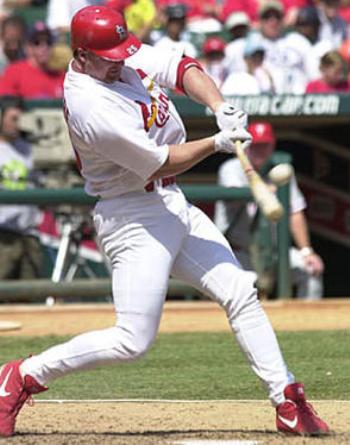
2. A common argument that has arisen since the announcement of Mark McGwire as hitting coach is that, “Because Mark McGwire was a power hitter, his “homerun swing” will make it impossible to coach a singles-type hitter.” Along with the proof of Skip Schumaker as a base-hit hitter with a high batting average, I would like to address a few basic points about McGwire’s swing when he was a ball player. Although McGwire had what some would call a “homerun swing,” his swing contained essential elements to being a successful all-around hitter. First, contrary to a stereotypical “homerun swing,” he successfully transferred his weight from his back foot to his front foot, and made contact with the ball out in front of the plate. Second, he hit against a firm front leg and also contrary to a “homerun swing,” finished with a 90 degree angle between his back foot and the ground, instead of “squishing the bug.” Third, he had a high follow-through which is important for any hitter, because it allows them to hit through the ball and get full extension. There were elements of his swing that made him hit homeruns, though. First, he started his swing by dropping his hands, which allowed him to get under the ball and hit towering fly balls for great distance. Second, after he finished his follow through: after his swing, he transferred his weight back to his back foot, which also helps to generate an upward stroke. If you eliminate these aspects of his swing by keeping the hands up at the beginning of the stride, and finishing balanced and out in front, the tall homeruns transform into scorching line-drives and the resulting product is a great swing.
3. As stated before, the most important part of a hitter’s game and a hitting coach’s job is preparing for the mental game. McGwire was a power hitter that took a calm approach to his swing, and had a game plan of capitalizing on the pitcher’s mistakes and dominating the pitch that he hit. Before stepping into the batter’s box, McGwire could be found with his eyes closed, going through visualizations about how he would hit the pitcher and what he would do in each situation. This is exactly the mindset that the Cardinals need when they go up to bat. McGwire will teach them how to be confident at the plate and to make sure they are the ones that dictate the game, not the pitcher.
Mark McGwire will be a successful hitting coach in St. Louis. Beyond skepticism from outside sources, Mark McGwire’s hitting instruction has already paid dividends for himself and other ballplayers, and will bring a stable source of hitting knowledge and instruction (physical and mental) to the table when he joins the Cardinals for the first Spring Training game on March 4, 2010.



Steven, I think you hit on some of the major issues of debate here. However, I wonder if the signing of McGwire will cause any sort of distraction within the clubhouse. Do you think that he will remain somewhat silent during his tenure, or if he doesn't do you think that the story won't be heavily covered by the media?
ReplyDeleteFor some sort of guidance on the issue, I found this place to be helpful:
http://www.kansas.com/sports/lutz/story/1027978.html
I agree overall in that he can bring many different positive things to the club, but what one must consider is the weighing of pro's and con's.